From Surviving to Thriving: Navigating the Shift to a High-Performing Classroom
MathSense AI · August 1, 2026
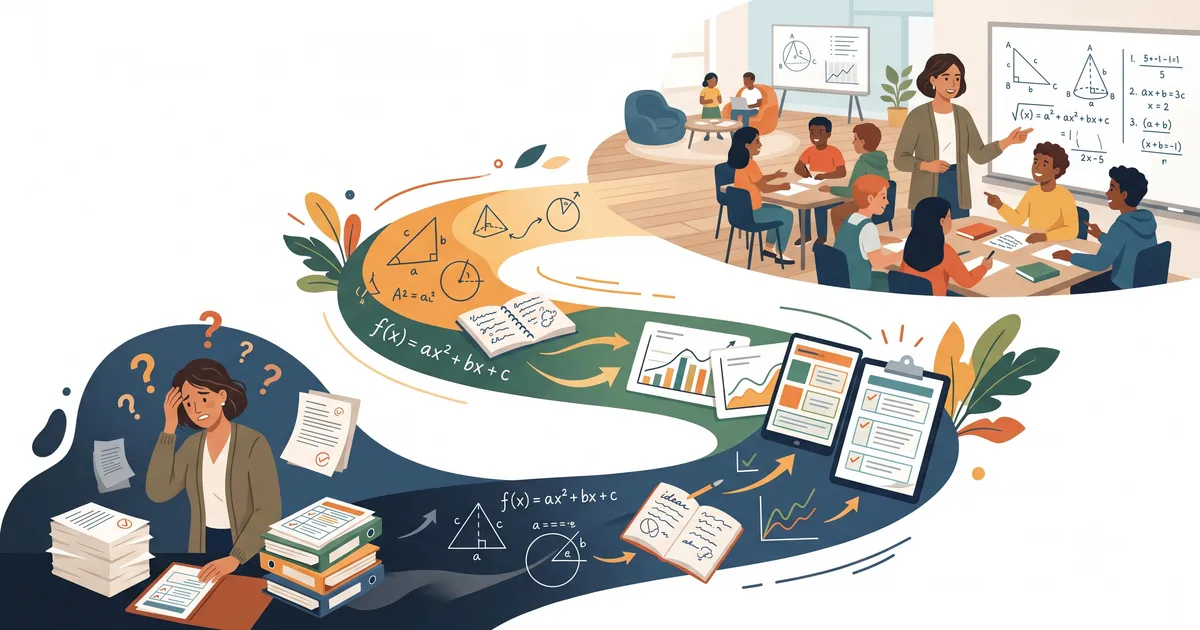
I recently came across a Reddit post from a teacher preparing to start at a new, high-performing school.
What struck me wasn't the move itself. It was one sentence:
"I'm terrified I won't be good enough."
Not because they didn't care.
Not because they weren't experienced.
They were worried that years of working in difficult circumstances had left them feeling behind when it came to lesson planning and instructional design.
As a former math teacher, I understood that feeling immediately.
Teaching in a challenging environment teaches you things that no professional development workshop ever can. You learn resilience. You learn how to adapt. You learn how to build relationships with students who need someone to believe in them.
But it can also leave very little time to think deeply about lesson design. When you're simply trying to get through each day, it's hard to experiment, reflect, and refine your practice.
Then one day you move to a school where expectations are different.
Suddenly you're wondering:
"Can I design lessons that are engaging enough?"
"Am I differentiating well enough?"
"Am I missing something everyone else already knows?"
Those questions don't mean you're a weak teacher.
They usually mean you care.
Lesson planning shouldn't feel like proving yourself
One thing I learned during my years in the classroom is that good lesson planning isn't about creating the most elaborate lesson.
It's about clarity.
What do I want students to understand?
How will they practise?
How will I know they've learned it?
Everything else builds from there.
When those questions are clear, lesson planning becomes much less overwhelming.
It also becomes much easier to adapt the lesson for different learners because you know exactly what you're trying to accomplish.
You don't have to start from a blank page
One of the hardest parts of planning isn't improving a lesson.
It's starting one.
Many Sunday afternoons were spent staring at an empty document wondering where to begin.
Ironically, once I had a rough outline, the rest became much easier. I could change activities, add examples from my own classroom, or adjust the pace for my students.
The blank page was always the hardest part.
That's one of the reasons I built MathSense AI.
Not because I believe AI should replace teachers.
It shouldn't.
Teachers know their students in ways that technology never will.
But I do think technology can remove some of the repetitive work that drains our time and energy.
If AI can produce a solid first draft of a lesson plan, then teachers can spend their time doing what matters most - thinking about their students, their classroom, and their teaching.
To me, that's a much better use of technology.
The same idea applies to feedback
The same thinking shaped another part of MathSense AI.
Marking mathematics takes time.
Writing meaningful feedback takes even longer.
Yet thoughtful feedback is one of the most valuable things we can give students.
Rather than asking teachers to choose between speed and quality, I wanted to build something that could handle the repetitive parts of grading while still giving teachers meaningful insights into student misconceptions.
The goal isn't to replace professional judgement.
It's to give teachers more time to use it.
You are probably more prepared than you think
If you're moving to a new school this year and wondering whether you're good enough, remember this:
You don't need to arrive with perfect lesson plans.
You don't need to know every strategy.
You don't need to teach the perfect lesson on day one.
The qualities that made you successful before - patience, adaptability, persistence, and genuine care for students - are still the foundation of excellent teaching.
The rest is something every teacher continues learning throughout their career.
I certainly did.
And I still am.
If technology can make that journey a little less overwhelming and give teachers back a few hours each week, then I think it's doing exactly what it should.
Helping teachers spend less time wrestling with paperwork and more time doing the work that only teachers can do.